WHOLE HUMAN BLOOD (Collection, Processing and Storage)
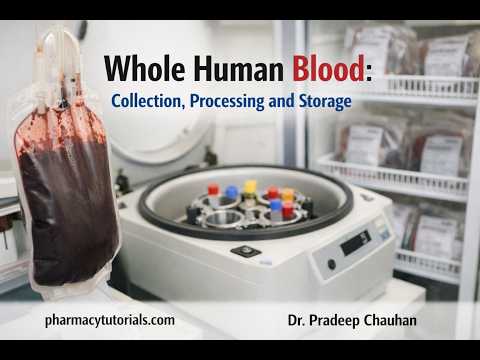
“Whole Human blood” means that the blood used for transfusion contains all the vital elements of the blood. Even when a small amount of sodium citrate is added to the blood (0.38 per cent), the blood represents "whole blood."
(Ref: Journal of the American Medical Association, June 2023).Collection
Any person in good health is accepted as a donor, but there are some conditions for donors. The average adult has 4 to 5 liters of blood. During a donation, only 350 to 420 ml of blood is drawn. About 8% to 12% of the total blood volume (depending on your weight), is taken during blood donation.
The donors shall fulfill the following requirements:
- The donor shall be in the age group of 18 to 60 years.
- The donor should not be anemic. The hemoglobin content of the blood should not be less than 13.5 and 12.5 for males and females respectively.
- The donor shall not be less than 45 kilograms.
- Temperature and Pulse of the donor shall be normal.
- The systolic and diastolic blood pressures are within normal limits without medication
- The donor shall be free from acute respiratory diseases.
- The donor shall be free from any skin diseases at the site of phlebotomy (site to puncture in a vein).
- The arms and forearms of the donor shall be free from skin punctures or scars indicative of professional blood donors or addiction of self-injected narcotics
- The donor is not suffering from any disease that can be transmitted by blood transfusion. i.e. syphilis, malaria, serum jaundice etc.
The blood is collected aseptically from the Median Cubital Vein, in front of the elbow, into a sterile container, containing an anticoagulant solution. Median Cubital vein is selected because it is typically large, superficial, and relatively stable, means, it does not roll easily under the skin during needle insertion.

During collection the bottle or pouch is gently shaken to ensure that blood and anticoagulant solution is mixed properly.
Not more than 420 ml. is taken in one attempt. Immediately afterward the collection, containers are sealed and cooled at 4-6°C.
Storage
Whole blood should be stored between +2°C and +6°C. This temperature range is critical to prevent bacterial growth and to maintain the integrity of blood cells, and same conditions should be maintained during transportation
Packed Red Blood Cells shall be separated from the whole blood from the date of collection.
-
(a) within 21days: if the whole blood is stored in ACD (Acid Citrate Dextrose) solution, and
(b) within 35 days; if the whole blood is stored in CPDA-1 (Citrate Phosphate Dextrose Adenine, Formula 1) solution. ,
Processing
The buffy coat method is a widely used technique in blood banks for the separation of whole blood into its major components—packed red blood cells (PRBCs), platelets, and plasma. This method allows optimal recovery of platelets and better quality of blood components.In this method, 350–450 mL of whole blood is collected aseptically into a sterile blood bag containing an anticoagulant, commonly CPDA-1.
After collection, the blood is allowed to rest briefly at room temperature (20–24°C) to stabilize the cells before processing.First (hard spin) Centrifugation
The collected whole blood is then subjected to first (hard) centrifugation. Centrifugation is carried out at an RCF (Relative Centrifugal Force) of about 1,000–1,200 × g for 10–15 minutes under controlled conditions.
This centrifugal force causes separation of blood components into three distinct layers based on their density.- Upper Layer: Contains Plasma (lightest part), being the least dense, remains at the top.
- Middle Layer: A thin buffy coat layer (containing platelets and leukocytes).
- Bottom layer: Red blood cells (RBCs) settle at the bottom due to their highest density,
 Following centrifugation, the primary blood bag is placed in a plasma extractor. Gentle and controlled pressure is applied on it to transfer the plasma layer into an attached satellite bag, without disturbing the buffy coat layer.
Now by this action, the uppermost layer of Plasma is transferred into satellite bag and remaining two layers, the bottom layer of RBC and middle buffy coat layer remain in the primary bag.
Then the blood bag is kept again in the plasma extractor, and a very gentle and controlled pressure is applied. Due to this the buffy coat layer, which lies above the RBCs layer, starts flowing out, and in this way the buffy coat is also transferred into another satellite bag. Pressure is stopped immediately once the buffy coat is removed.
Now the primary bag contains only packed red blood cells (PRBCs), which are sealed and stored under refrigerated conditions for transfusion use.
Following centrifugation, the primary blood bag is placed in a plasma extractor. Gentle and controlled pressure is applied on it to transfer the plasma layer into an attached satellite bag, without disturbing the buffy coat layer.
Now by this action, the uppermost layer of Plasma is transferred into satellite bag and remaining two layers, the bottom layer of RBC and middle buffy coat layer remain in the primary bag.
Then the blood bag is kept again in the plasma extractor, and a very gentle and controlled pressure is applied. Due to this the buffy coat layer, which lies above the RBCs layer, starts flowing out, and in this way the buffy coat is also transferred into another satellite bag. Pressure is stopped immediately once the buffy coat is removed.
Now the primary bag contains only packed red blood cells (PRBCs), which are sealed and stored under refrigerated conditions for transfusion use.
Second (soft spin) Centrifugation
The buffy coat bag is then subjected to a second centrifugation step, called a soft spin. This soft spin is performed at a lower centrifugal force and shorter duration (Low RCF ≈ 150–400 × g and for ~5–10 minutes) compared to the initial hard spin. During this soft centrifugation, white blood cells gets sedimented at the bottom of the buffy coat bag, while platelets remain suspended in the upper plasma portion. After centrifugation, gentle pressure is applied using a plasma extractor to separate the upper layer of platelet-rich plasma from the leukocyte sediment. The platelet-rich plasma obtained from the buffy coat bag is transferred into another satellite bag and further processed, to prepare platelet concentrate. The remaining portion, which mainly contains white blood cells, can be further processed as per requirements.
Testing of Blood
There are lots of tests were performed to check the blood before transfusion or any other processing (separation of blood components).
- Serological test for syphilis
- Determination of blood groups
- Determination of Rh factor
- Test for sterility
- Test for presence of any visual changes
- Test for presence of any communicable disease-causing agent.
Preservation of Blood
Blood collection packs contains some solution, which serves various functions like anticoagulants and cell nutrients (RBC preservatives). These solutions contain glucose for cell nourishment and chemical to prevent coagulation.
In the absence of calcium ion, the blood cannot coagulate. Citrate as an anticoagulant bind with free or ionized calcium and prevent blood clotting. CPDA-1 means Citrate Phosphate Dextrose Adenine – formula 1.